

The amount of money being spent globally on computing hardware, primarily graphics processing units and servers, to power artificial intelligence (AI) is enormous and growing rapidly. IDC estimates that $153 billion was spent in 2024, doubling to $318 billion in 2025. Morgan Stanley forecasts the total capital expenditures on computing and data centers could be $2.9 trillion from 2025 to 2028. And because much of the technology hardware may need to be replaced every four to six years, this is not simply a one-time investment. These figures don’t even include the electricity and other infrastructure needed to power these facilities. S&P Global estimates that U.S. energy utilities alone plan approximately $1.3 trillion of capital expenditures between 2026 and 2030, with rapidly growing electricity demand from data centers among the major drivers.
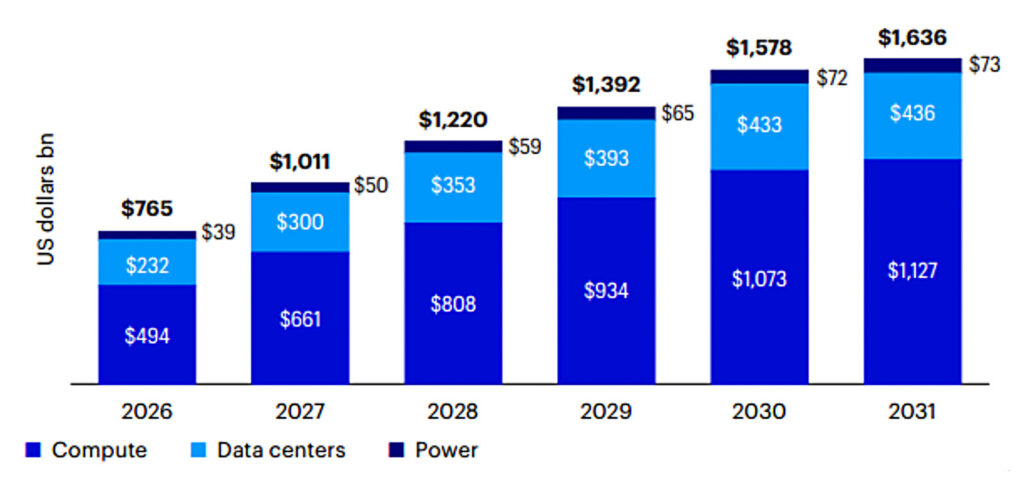
The demand for AI is clearly real, but will it ultimately be large enough to justify the multi-trillion-dollar investment being made to meet it? Nobody knows the answer, and there is certainly no shortage of opinions. Today, AI is being used primarily in three areas: coding, performing work for businesses, and serving as a personal assistant for consumers. Demand for AI coding tools is escalating rapidly, while businesses are increasingly using AI to perform tasks that were previously done by employees. Consumer use of AI personal assistants is also growing, although perhaps more slowly than the other two major applications.
Today, there is not enough infrastructure to meet the demand for AI. There are shortages of computing hardware, networking equipment, data-center capacity and electricity. Sterling Infrastructure, a major data center construction company, has said some projects are being booked now to start in 2028 and 2029. See the source from ROIC. Therefore, in the current environment, it is difficult to argue that we are in an AI infrastructure bubble. Supply is ramping up quickly over the next several years, but so is demand.
One additional factor makes this particularly difficult to forecast: technological improvements could allow new generations of equipment to perform dramatically more work than today’s equipment. If that happens, the amount of computing capacity required to support a given level of AI usage could be substantially lower than today’s projections suggest. Conversely, AI adoption could grow so rapidly that even these efficiency gains are overwhelmed by demand. With so many variables, we probably won’t know until 2028–2030 whether the industry has overbuilt AI infrastructure.
From a stock-market perspective, the picture is somewhat more reassuring. As of 9/11/2026, Large U.S. stocks, as measured by the S&P 500, both market-cap weighted and equal weighted, are currently roughly in line with their five- and ten-year historical forward price to earnings averages. Small U.S. stocks are also trading at valuations that are below their historical averages.
What does this tell us? At a minimum, it suggests that stock prices have not risen as quickly as earnings. Investors are not currently willing to pay substantially more for each dollar of earnings than they have in the past. That argues against the idea that the overall U.S. stock market is in a valuation bubble.
That doesn’t mean stocks are without risk. Higher interest rates, slower economic growth, weaker corporate earnings or an eventual overbuild of AI infrastructure could all lead to lower stock prices. But based on current valuations, the stock market does not appear to be pricing in an enormous amount of additional optimism. In our view, that provides some comfort even as the AI investment cycle continues to unfold.